


The Philadelphia neighborhoods that feel most like the suburbs are in the city’s northwest corner: Chestnut Hill, Mount Airy, Roxborough and East Falls all pair quiet, tree-lined streets with Regional Rail service to Center City, and all sit along the 2,042-acre Wissahickon Valley Park. Chestnut Hill feels the most suburban of the four, with a cobblestone main street, a 92-acre public arboretum and two train lines, while still being inside city limits at the 19118 ZIP code. This guide compares the four so you can choose the one that fits how you want to live.
What makes a Philadelphia neighborhood feel suburban?
Renters who say they want “suburban” usually mean four things: green space they can walk to, streets that are quiet at night, a small main street instead of a busy commercial strip, and room to spread out. They usually do not want to give up a train to the city. Northwest Philadelphia is the one part of the city where you can have all of it, because the Wissahickon Valley runs through the middle and keeps development low and spread out.
One detail that surprises newcomers: Wissahickon Valley Park is the second-largest park in Philadelphia, with about 50 miles of trails. Its main path, Forbidden Drive, got its name in the 1920s, when about 1,000 riders on horseback protested a plan to let cars into the park and won. More than a century later, the drive is still car-free.
How do Chestnut Hill, Mount Airy, Roxborough and East Falls compare?
| Chestnut Hill | Mount Airy | Roxborough | East Falls | |
|---|---|---|---|---|
| Feel | Most suburban: historic stone buildings, gardens, quiet evenings | Leafy and community-minded, with a strong neighborhood identity | Hilly and residential, with a relaxed small-town pace | Compact and riverside, closest to the city |
| Main street | Germantown Avenue (cobblestone) | Germantown Avenue (stone-paved) | Ridge Avenue | Ridge Avenue and Midvale Avenue |
| Signature green space | Wissahickon Valley Park, Morris Arboretum & Gardens, Pastorius Park | Wissahickon Valley Park, Cresheim Valley | Wissahickon Valley Park, Upper Roxborough Reservoir Preserve, Schuylkill Center | Schuylkill River Trail |
| Regional Rail | Chestnut Hill East and Chestnut Hill West | Chestnut Hill East and Chestnut Hill West | Manayunk/Norristown (nearby) | Manayunk/Norristown |
| Average rent (RentCafe) | $1,900 | $1,522 (West) / $1,410 (East) | $1,704 (Upper) / $1,808 (Central) | $1,652 |
| Good fit for | Renters who want the most green space and a calm, village setting | Renters who value a close-knit, diverse community | Renters who want hills, views and a low-key pace | Renters who want the shortest trip to Center City |
Average rents are RentCafe neighborhood averages as of fall 2026 and vary by building and unit size.
Chestnut Hill: the most suburban-feeling neighborhood inside city limits
Chestnut Hill sits at the top of the city, bordered by Montgomery County on the north and the Wissahickon on the west. Morris Arboretum & Gardens, the official arboretum of Pennsylvania, covers 92 acres with more than 11,000 labeled plants. Germantown Avenue is lined with independent shops, cafés and bakeries. About half of Chestnut Hill households rent, so it’s a real renter’s neighborhood, not just a place to visit.
Mount Airy: leafy streets and a strong sense of community
Just south of Chestnut Hill, across the Cresheim Valley, Mount Airy is known for its large stone houses and for being one of the first successfully integrated neighborhoods in the country. Weavers Way Co-op, a long-running grocery cooperative, anchors much of neighborhood life. It shares both train lines with Chestnut Hill.
Roxborough: hills, views and trails
Roxborough sits across the Wissahickon from Mount Airy. Visit Philadelphia highlights its 35-acre Upper Roxborough Reservoir Preserve and the Thomas Mill Bridge, the city’s only covered bridge. Ridge Avenue is its main street.
East Falls: the shortest trip downtown
East Falls sits along the Schuylkill River, closer to Center City than the other three, with the Schuylkill River Trail at its edge. It feels more compact and less secluded, which suits renters who put commute time first.
Where Chestnut Hill Village fits in
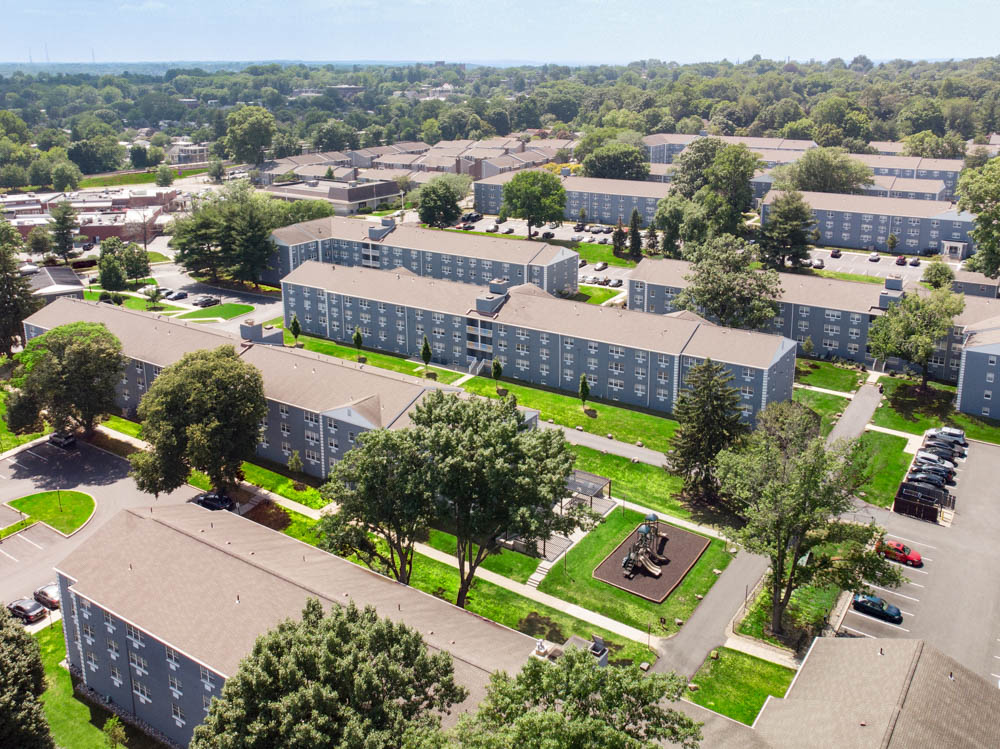
Many suburban-feel neighborhoods in Philadelphia are mostly single-family homes, so finding an apartment community with real amenities can be the hard part. Chestnut Hill Village Apartments, at 7715 Crittenden Street, offers one- and two-bedroom apartments and two- and three-bedroom townhomes, a short walk from Wyndmoor station. Residents have a landscaped pool, fitness center, yoga room, game room, playground, fire pits, a pet spa and a bark park. Read more in our renter’s guide to Chestnut Hill, browse floor plans, or see the full list of amenities.
Frequently asked questions
What part of Philadelphia feels the most like the suburbs?
Northwest Philadelphia, especially Chestnut Hill. It has a small cobblestone main street, large parks and gardens, quiet residential streets and two Regional Rail lines to Center City.
Is Chestnut Hill in Philadelphia or the suburbs?
Chestnut Hill is inside Philadelphia city limits, in the 19118 ZIP code, at the city’s northwest edge next to Montgomery County.
What is the quietest walkable neighborhood in Philadelphia to rent in?
Chestnut Hill and Mount Airy are both quiet and walkable, with shops along Germantown Avenue and direct access to Wissahickon Valley Park.
Which Philadelphia neighborhoods have the most green space?
Neighborhoods along Wissahickon Valley Park, including Chestnut Hill, Mount Airy and Roxborough. The park covers about 2,042 acres with roughly 50 miles of trails.
Are there apartment complexes in Chestnut Hill with amenities?
Yes. Chestnut Hill Village Apartments has a pool, fitness center, yoga room, game room, pet spa and bark park, plus many units have in-home washers and dryers.
Helpful links
- Friends of the Wissahickon for trail maps and park events
- Morris Arboretum & Gardens
- RentCafe Philadelphia rent trends
- Visit Philadelphia: Roxborough
See why Chestnut Hill feels like home. Schedule a tour of Chestnut Hill Village Apartments or call (215) 242-3500.

.jpg)